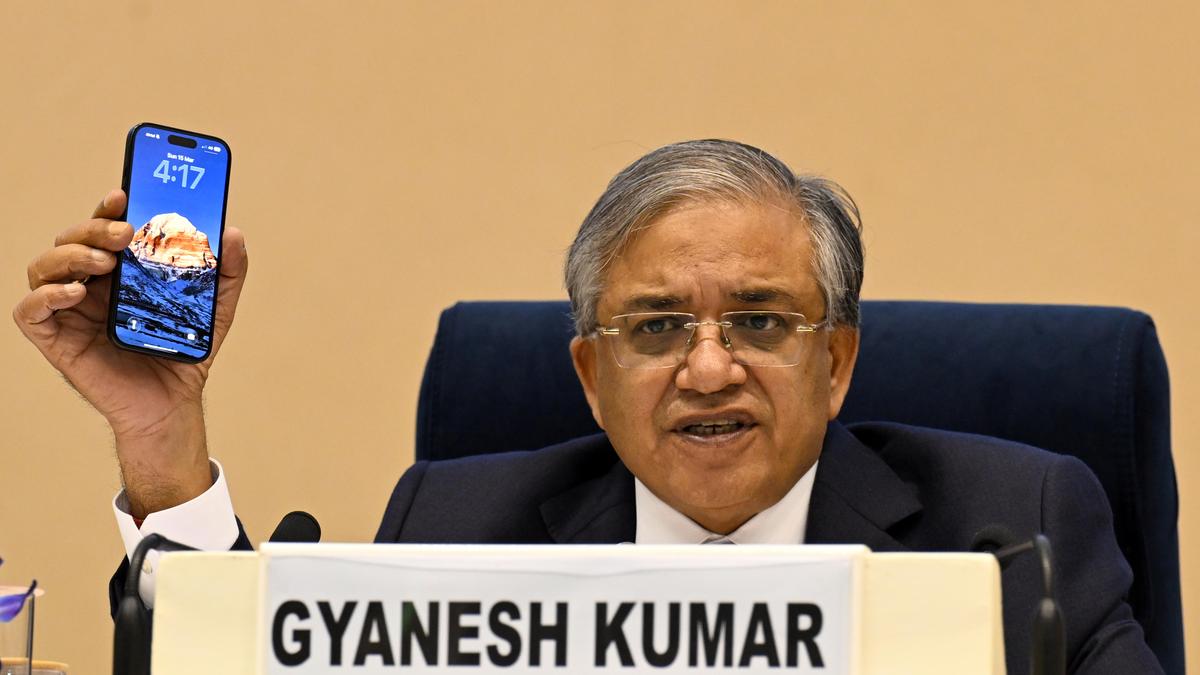
Chief Election Commissioner Gyanesh Kumar during the announcement of elections to Assemblies of five States and Puducherry in New Delhi on March 15, 2026.
| Photo Credit: R.V. Moorthy
Assembly election would be held in a single phase in Assam, Puducherry and Kerala on April 9 and in Tamil Nadu on April 23, while West Bengal will vote on April 23 and April 29, the Election Commission of India (ECI) announced on Sunday.
Counting for all four States and the Union Territory of Puducherry would be held on May 4. The Model Code of Conduct (MCC) has come into effect immediately with the announcement of the poll schedule.
Assembly elections 2026 highlights
Addressing a press conference here, Chief Election Commissioner (CEC) Gyanesh Kumar said a total of 17.4 crore electors will vote in 824 Assembly constituencies across these four States and one UT. Around 25 lakh polling personnel would be deployed at 2.19 lakh polling stations.

End of terms
The term of the Tamil Nadu Assembly, which has 234 seats, gets over on May 10, while that of Kerala, which has 140 seats, gets over on May 23. Assam has 126 constituencies, and the term of its Assembly ends on May 20, while the 294-seat West Bengal Assembly completes its term on May 7. The term of the 30-seat Puducherry Assembly ends on June 15.
In West Bengal, 152 constituencies will vote in the first phase and 142 in the second.
The ECI also announced by-polls to eight Assembly constituencies. By-elections to five seats—Ponda in Goa, Bagalkot and Davanagere South in Karnataka, Koridang in Nagaland and Dharmanagar in Tripura—will be held on April 9. Elections in three other constituencies—Umreth in Gujarat, and Rahuri and Baramati in Maharashtra—will be conducted on April 23. Counting of votes for the bye-elections will also be held on May 4.

The by-polls have been necessitated due to the death of sitting MLAs.
“Bedrock of democracy”
Asserting that “pure electoral rolls” are the “bedrock of democracy”, Mr. Kumar told the media that the process of Special Intensive Revision (SIR) of electoral rolls was one of the 30 new measures undertaken by the poll panel over the last 12 months to ensure free and fair polls.
The exercise, which began in Bihar last year, has since been held across 13 States and Union Territories. It has been particularly contentious in West Bengal, where the Supreme Court has directed that the over 60 lakh cases listed under “adjudication” be decided by court-appointed judicial officers.
Responding to a question whether these cases would be disposed of before the scheduled election dates, Mr. Kumar said: “As far as the supplementary list under adjudication is concerned, learned judges are looking into case by case, and those approved by them shall be included in the final electoral rolls by way of a supplementary list, in accordance with the order of the Supreme Court.”

MCC in force
On a question regarding certain schemes announced by West Bengal Chief Minister Mamata Banerjee barely hours before the election dates were declared, the CEC said the “Model Code of Conduct” is applicable from now onwards. Actions taken prior to the MCC is a prerogative of the concerned governments”.
Explaining why West Bengal will vote in two phases instead of eight phases as in the previous Assembly polls, he said that the ECI held detailed deliberations and in “its considered opinion, it was found necessary to reduce the number of phases and bring it down to an extent where it is convenient for everybody”.

The CEC declined to comment on an Opposition-sponsored motion seeking his removal submitted in Parliament, saying he did not wish to engage with political statements made by certain political leaders and parties against the ECI.
Strict action warned
He asserted that elections in all four States and Puducherry shall be conducted in a violence-free and inducement-free manner, and the poll panel would take strict action in case of violations.
About police officers accused of involvement in poll-related violence in the past elections in West Bengal, he said a list has been sought, and necessary action would be taken in accordance with the law.
Replying to a question on misinformation and deepfakes, Mr. Kumar said State nodal officers would continue to monitor such content, take it down and register FIR where necessary.
Published – March 15, 2026 04:57 pm IST